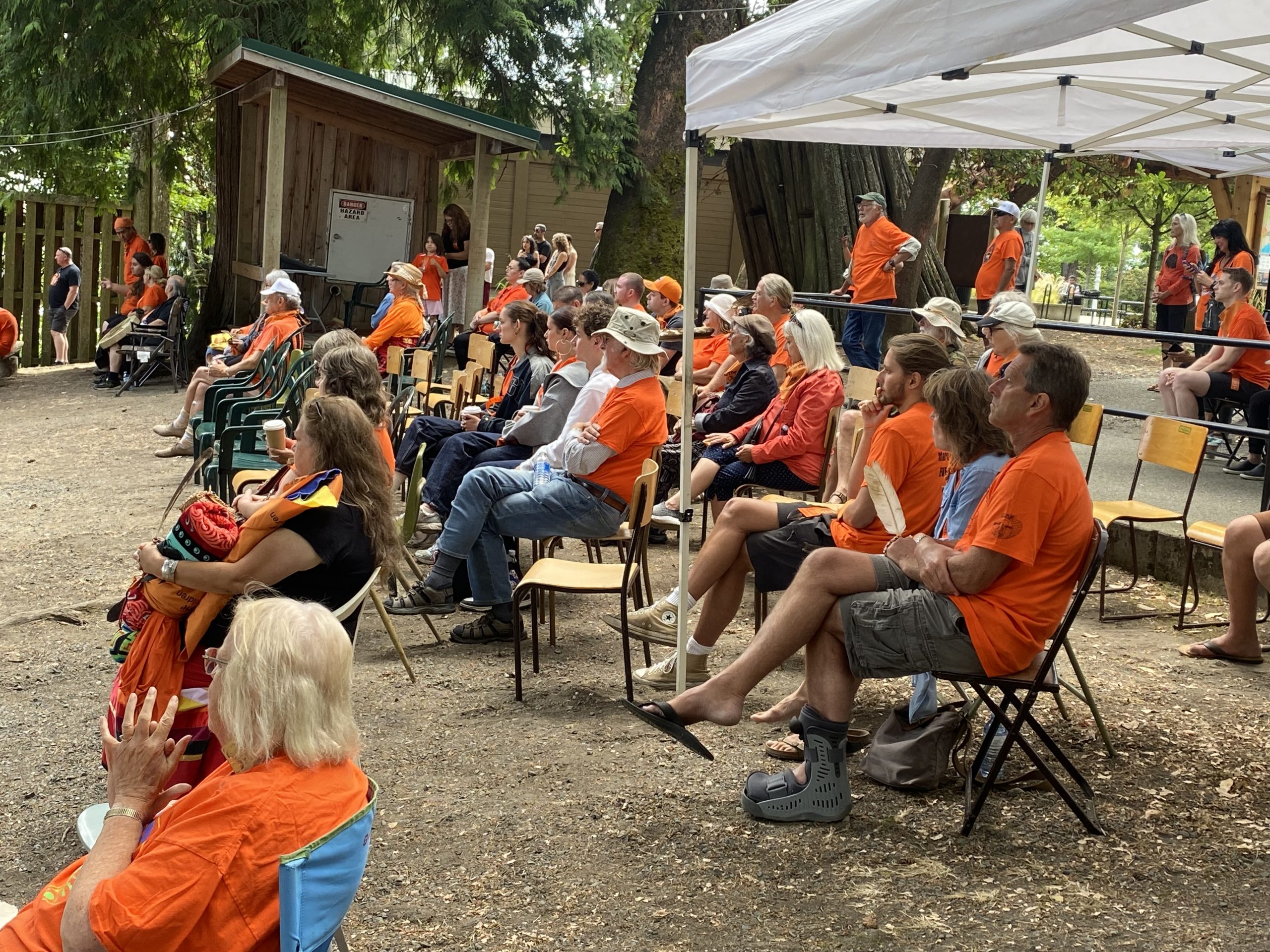
Researchers working with the Penelakut community have revealed a horrific legacy of disease and death that took place at Kuper Island Residential School for nearly a century.
Following the fifth annual Spune’luxtth’ March for the Children in Chemainus on Monday, new findings were shared to a gathering of several hundred marchers who gathered in Waterwheel Park.
Much of the research material was shocking.
“Kuper Island Industrial Residential School was well documented as a place of abuse and trauma,” lead researcher Ashley Whitworth said. “(The number of) survivors of the school who died after discharge from sickness and unnatural causes is awfully high.”
In 1919, a survey was conducted to track the condition of the former students. The results indicated that 35 per cent or 116 of 329 had died, Whitworth reported.
“Disease devastated community populations. This school had statistically higher numbers of deaths due to TB and related diseases than other researched Indigenous populations by nearly double, a 30 per cent death rate in the early years, and the average rate of Indigenous death, according to the National Medical Association, was already six times higher than that of non-indigenous populations.”
Working closely with the community, Whitworth and colleague Andrew Martidale a UBC professor and archaeologist, began in February 2024 to gather information about the school that opened in 1893. It has been a daunting task, but a great deal has been accomplished.
“One of the most limiting challenges every research community faces is getting access to records about them. For example, we are still waiting on requests we submitted almost a year ago.”
Whitworth says they have “high confidence” that they have found all the names of children who attended the school between 1890 and 1953. They started with data provided by the National Centre on Truth and Reconciliation (NCTR) that had a student list with 2,120 names.
“Through our work, we have been able to convert more than 500 children from unknown to known. We have uncovered more than a hundred duplicates within the original NCTR list and have since identified and added significantly more than a hundred new students,” Whitworth said.
“The gaps in records stem not only from clerical errors but also from the financial-focused approach to reporting, which dehumanizes the child to a number.”
The NCTR’s memorial list had about 121 names and researchers are working to confirm that number.
“Our in-progress research from 1890 to 1953 can confirm 85 deaths through the records. The research team is tracking the other 32. Archival evidence strongly suggests that there are more deaths based on notes to file, death certificates and community knowledge,” Whitworth said.
“We are investigating an additional 30-40 deaths that occurred from 1890 to one to two years after the closure of the school that can be directly related to Kuper.”
Confirming other suspected deaths has also been difficult but there is strong evidence, often obtained from Penelakut community members, of numerous deaths due to students attempting to escape the school.
“From as early as 1898, students attempted to escape by swimming or crossing the channel in canoes or small boats. Many of these children did not make it to the other side.
“We are tracing 16 students who died of suspicious causes,” Whitworth said.