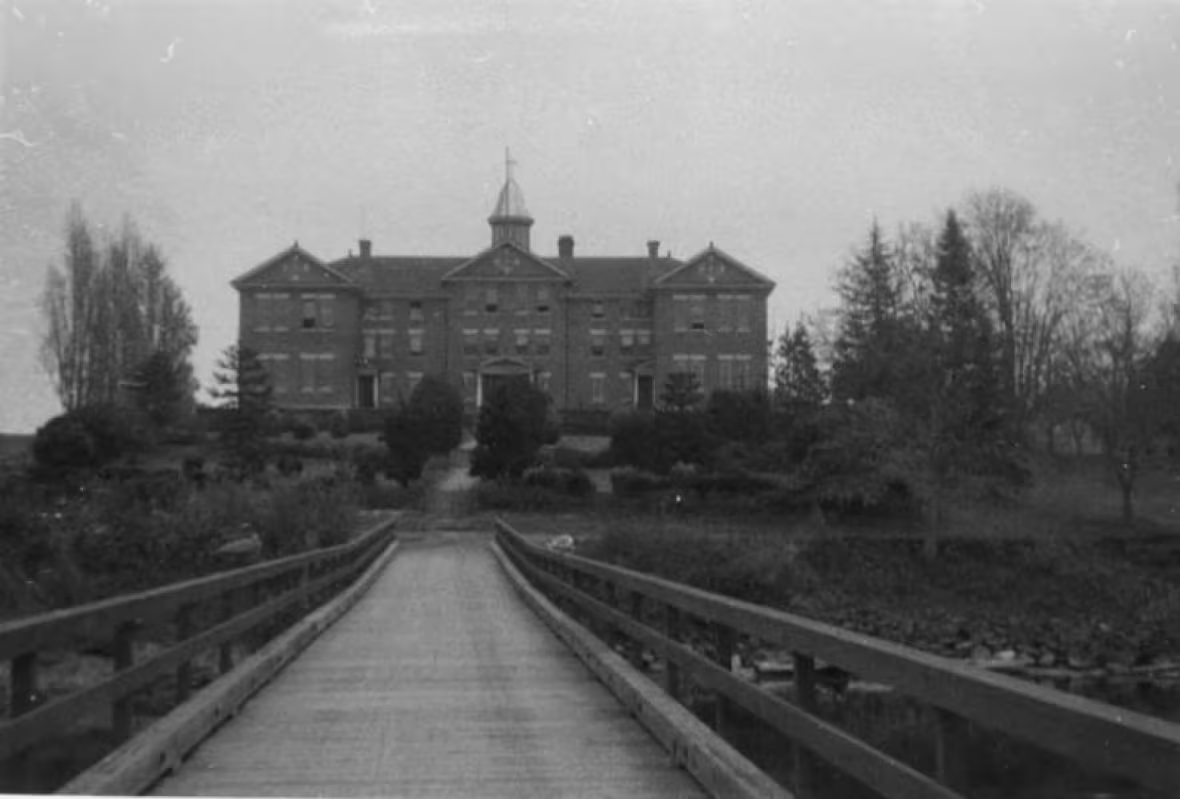
Researchers have determined that there could be as many as 342 unmarked graves on Penelakut Island containing the bodies of children who attended Kuper Island Residential School.
In a grim update delivered by University of British Columbia professor and archaeologist Andrew Martindale following the Spune’luxtth’ March for the Children held in Chemainus on Monday, details about murder and suspicious deaths were revealed, for the first time in some cases.
Before he died, Kuper Island Residential School survivor Monty Charlie shared a horrific story about the death of a young girl at the school.
“As part of his healing journey he wanted others to know of his experience,” Martindale explained. “He showed me where he was sexually assaulted. And he related story of a child’s murder.”
Charlie told Martindale that he had seen a nun push a little girl out of a third-floor window at the school. He pointed out the exact location where the child was buried.
“They buried her beside an apple tree to the south of the main school building. The stump of this tree remains there today, and Monty showed us the precise location of where she was buried.”
Martindale says ground-penetrating radar revealed a clear pattern of a child-sized, unmarked grave at that location. The research team is working to find the identity of the girl, but Martindale says it has been difficult.
“It will not surprise you that an effort was made by the school staff to hide her identity and her death.”
Researchers have been working for several years and have now scanned 3,500 square metres searching for evidence of bodies buried on the island.
Using ground-penetrating radar and other technology, Martindale says it has been determined that there are 111 possible graves, 133 probable graves and 98 likely graves.
“Their identification would require forensic excavation at considerable effort and expense,
There is a spiritual and emotional cost and the Elders have not yet decided how to proceed,” Martindale said.
“All work is to be done in relation and following Penelakut laws and all results belong exclusively to Penelakut.”
As well as being buried underground, Martindale says the team is investigating the stories of children being incinerated or dumped into the ocean.
Archival photographs show a building containing a furnace in which it is believed infants – the products of sexual abuse by the priests on girls and sexual activity between nuns and boys resulting in pregnancies – were incinerated.
“We have reports that these resulted in aborted fetuses and murdered infants, and we know of two locations near the school buildings that were used to bury them,” Martindale said.
Researchers know the location of the furnace, but it will be very difficult to find evidence of these deaths.
“We’ve consulted with forensic anthropologists, and it would be very challenging. The Elders have not yet decided how to proceed,” Martindale said.
Similarly, reports that the bodies of children were dumped in the water off the school’s dock or from boats crossing the Strait, are going to be difficult to confirm.
“It’s going to be very challenging. We do not know if the remains of children can be found.”
The presence of unmarked graves – a fact that Penelakut people have known for generations – makes it difficult for development to take place on the Island.
“Any new construction would disturb encounter and disturb unmarked graves,” Martindale points out. “It’s a reminder of what it means to live in the shadow of a residential school.”
Martindale’s report to the community on Monday was the first time much of this research has been made public. He says while the work will continue, it will not be easy, given the lack of proper funding.
“The model under which we have worked so far is inadequate. Survivors should not have to depend on volunteers to locate the unmarked graves of children who died at residential schools.
“In any other context the search for children who died at school would be a national priority. We must ask ourselves why it is not.
“Canada has an obligation to remediate crimes the committed against Indigenous peoples in many ways,” Martindale said.