Chemainus business owner and North Cowichan councillor Chris Istace is frustrated by the pace of progress in determining a plan for the Island Rail Corridor.
Istace, who also sits on the Cowichan Valley Regional District Board, says it’s disappointing that no concrete plan has emerged since the rail line closed in 2011.
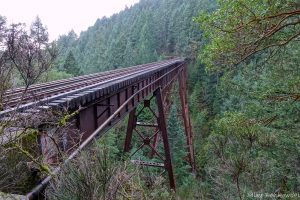
“We keep wasting time non-stop,” Istace said. “We’re spinning our wheels. Istace said the ongoing “nation to nation” negotiations involving local First Nations and the various levels of government are also going to delay action.
The CVRD received a report from Stantec, a multi-national consulting firm, in February following a year-long study into the future of rail traffic and other potential uses of the corridor between Victoria and Courtenay.
The CVRD contracted with Stantec in the Spring of 2024 to support the CVRD in undertaking this project. A comprehensive engagement and collaboration process was delivered to work towards a shared vision for the rail corridor. It included collaboration with other Regional Districts, a Working Group, and the ICF; as well as engagement with First Nations, stakeholders and the public.
Stakeholders and the public were engaged to better understand their hopes for the future use of the corridor.
The public expressed a strong desire for rail, with 79 of people selecting passenger rail as a transportation mode that best matches their vision for the future. This was followed by support for biking and hiking trails with almost 50 per cent of those surveyed stating they would support that use.
Istace is on-board with the latter option, despite its high cost.
The Stantec report estimates the cost of creating rail and trail on the corridor at just over $1 billion with annual costs of $32.3 million.
“Enabling rail and trail on the corridor is the highest cost option due to the trail requirements adjacent to rail line,” the report stated. “This preserves the opportunity for rail in the future when a business case can be made and funding secured for both infrastructure and operations.”
Istace says he is hopeful that senior governments will see the need to make expenditures of this nature in the name of infrastructure investments.
Stantec estimates the cost of rail only at $901 million with annual operating costs of $32 million.
The least expensive option would be to turn the entire corridor into a trail.
“The selection of the lesser cost of $55 million option of trail only would preclude rail in the future as parts of the trail would be constructed on the existing rail bed,” Stantec explained. “Costs reflect trail construction only and assume that soil remediation is not required. If required, the cost of soil remediation could range between $76 million and $225 million for the CVRD section of the corridor in addition to the $55 million trail cost.”
Seven stations would be used throughout the corridor if the rail option is implemented: Courtenay, Qualicum, Parksville, Nanaimo, Duncan, Westhills and Victoria.
Background
• The Island Corridor Foundation (ICF), a non-profit society composed of First Nations and regional governments, has owned the Island Rail Corridor since 2003.
• Passenger operations ceased on the Corridor in 2011 due to safety concerns.
• With rail corridor not being used for rail purposes continuously for two years, Nations with bisected Reserve land may under some circumstances seek reversion of the lands. In 2015, with the lands no longer being used for railway purposes, the Snaw-Naw-As First Nation began seeking the reversion of former Reserve Lands through legal action against Canada and the Island Corridor Foundation.
• In 2016, Cowichan Tribes and Halalt First Nation filed similar court claims, however these claims are currently in abeyance while the Snaw-Naw-As First Nation action has proceeded.
• The Esquimalt & Nanaimo (E&N) Railway, also known as Island Rail Corridor, is a short line railway on Vancouver Island. It generally runs parallel to the Trans-Canada/ Highway between Victoria and Courtenay, with a branch line from Nanaimo to Port Alberni, generally running along to Highway 4.
• The Island Rail Corridor was built in 1886 by Robert Dunsmuir and was sold to Canadian Pacific in 1905 and consists of various segments including the Victoria Subdivision, the Port Alberni Subdivision, and the Wellcox Spur. The portion within the Cowichan Valley Regional District (CVRD) is a part of the Victoria Subdivision.
• In 1979, VIA Rail assumed operational responsibility for the E&N Railway passenger service.
• By the late 1990s freight operations were sold to Rail America in 1998. In 2003, it became evident that Rail America had plans to discontinue the rail operations.
• Acknowledging the significant socio-economic impact of the corridor, the five Regional Districts and 14 First Nations in the area collaborated to establish the Island Corridor Foundation (ICF). The ICF became the owner of the corridor, with the mission to safeguard and enhance the rail corridor on Vancouver Island. Their efforts aimed to ensure the continued viability and development of this vital rail corridor.
• In February 2006, the Canadian Pacific Railway donated its 225 km portion of the railway right-of-way, which averages 30.48 m (100 ft) in width between Victoria and Courtenay, to the ICF.
In 2011, due to the disrepair of the railway, VIA Rail and Southern Railway suspended the Dayliner passenger service between Victoria and Courtenay indefinitely. The service had scheduled stops at Duncan, Nanaimo, and Parksville, with many other flag (on-request) stops along the way.