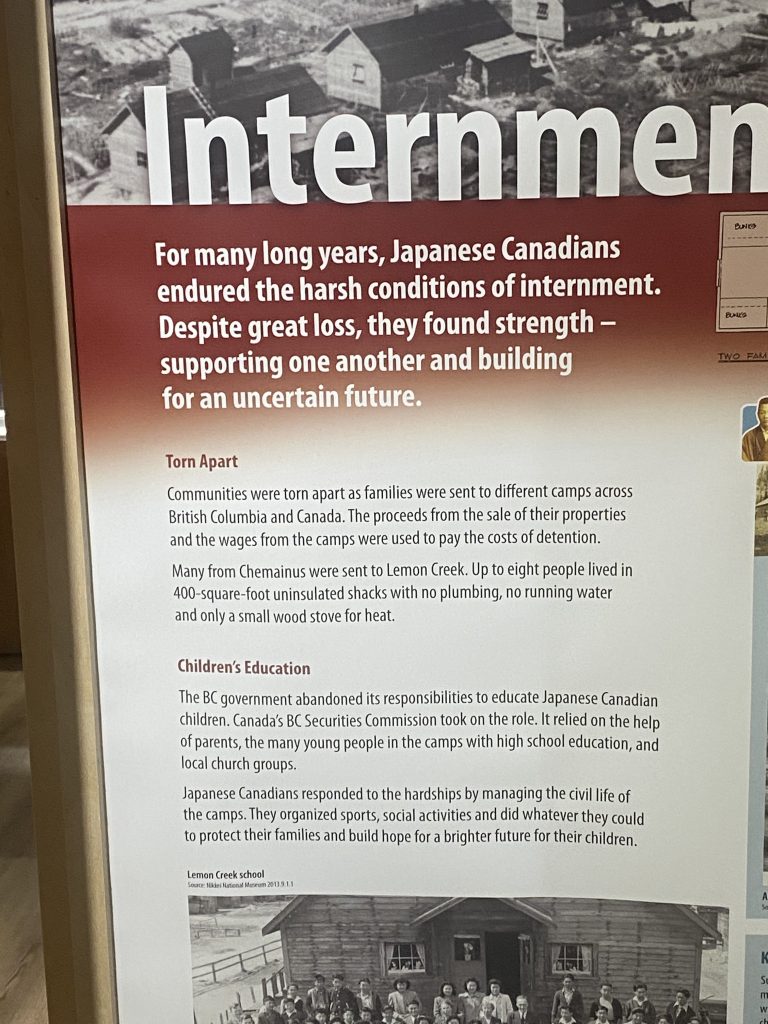
Led by the Chemainus Valley Historical Society and joined by several community groups, a poignant exhibition has been developed in the Chemainus Museum.
None Came Back, was officially opened to the public on July 11 with dignitaries and members of Japanese families that were impacted by a dark period in the history of Chemainus in attendance.
“In just one day, on April 21, 1942, Chemainus lost more than 300 of its residents. Men, women and children. Most were Canadian citizens,” Hiram Beaubier told the audience gathered in Waterwheel Park for the event.
Beaubier, a member of the Historical Society that teamed up with the Chemainus Festival of Murals, the Chemainus Library, Chemainus Secondary Grade 7 class, and a number of community members, gave a stark reminder of what occurred in Chemainus 75 years ago.
“Just behind me was the mill dock, where on that spring day, a long line of people carrying suitcases and bundles walked down to the waiting ship. They stepped out of their community into an unknown future,” Beaubier said.
The exhibition documents how international, national and local events came together to disrupt the lives of Japanese Canadians living in Chemainus, changing the community forever.
The exhibition was built around the story of the Kawahara family, whose children, Kazumi and Futaye, were in school when the family was interned. They were exiled to Japan and returned to Canada as young adults.
Beaubier said the story of the Yano family began on a farm near Duncan, blends with the Koyanagi family in Chemainus and carries forward to the sixth generation, still calling the Cowichan Valley home.
“Their story shows that the absence of prejudice opens choice and opportunity,” Beaubier commented.
A special feature of the exhibition is the contribution by the Grade 7 class of the Chemainus high school. The class studied the history of Japanese Canadians of Chemainus, and their projects summarize the key lessons learned. They are on display at the museum and at the Chemainus Library.
“A special thank you is due to those students who generously agreed to lend their projects to the museum,” Beaubier said.
“Keira Mackay at the Chemainus Library has been an active partner in this project since early days. The library has opened space for displays, developed reading lists and brought in books about the history of Japanese Canadians.”
Historical Society president Ron Waller said he was pleased to see Japanese family members in attendance.
“Your presence here provides an important link to the past and is a tribute to those who, for more than half a century, actively contributed to the growth and development of Chemainus,” Waller noted. “Their legacy remains a part of the community.”
Beaubier saluted the Museum board for taking a risk when the gem of an idea for the exhibition was first planted in 2024.
“The story told here is one that played out across Vancouver Island. In Crofton, in Duncan, in Paldi, and through the Gulf Islands. In Nanaimo and in Cumberland and in Port Alberni, Tofino and Ucluelet on the west coast.
“While each individual story is unique, all are sadly similar,” Beaubier said.
“The exhibition raises questions about what might have been if justice and compassion had overcome prejudice and fear.
“But the exhibition is also about the resiliency and determination of Japanese Canadians, faced with such injustice and so many challenges. It serves as a reminder not to be afraid to discuss the burdens of the past and it provides an opportunity for reflection relevant to today’s world.”