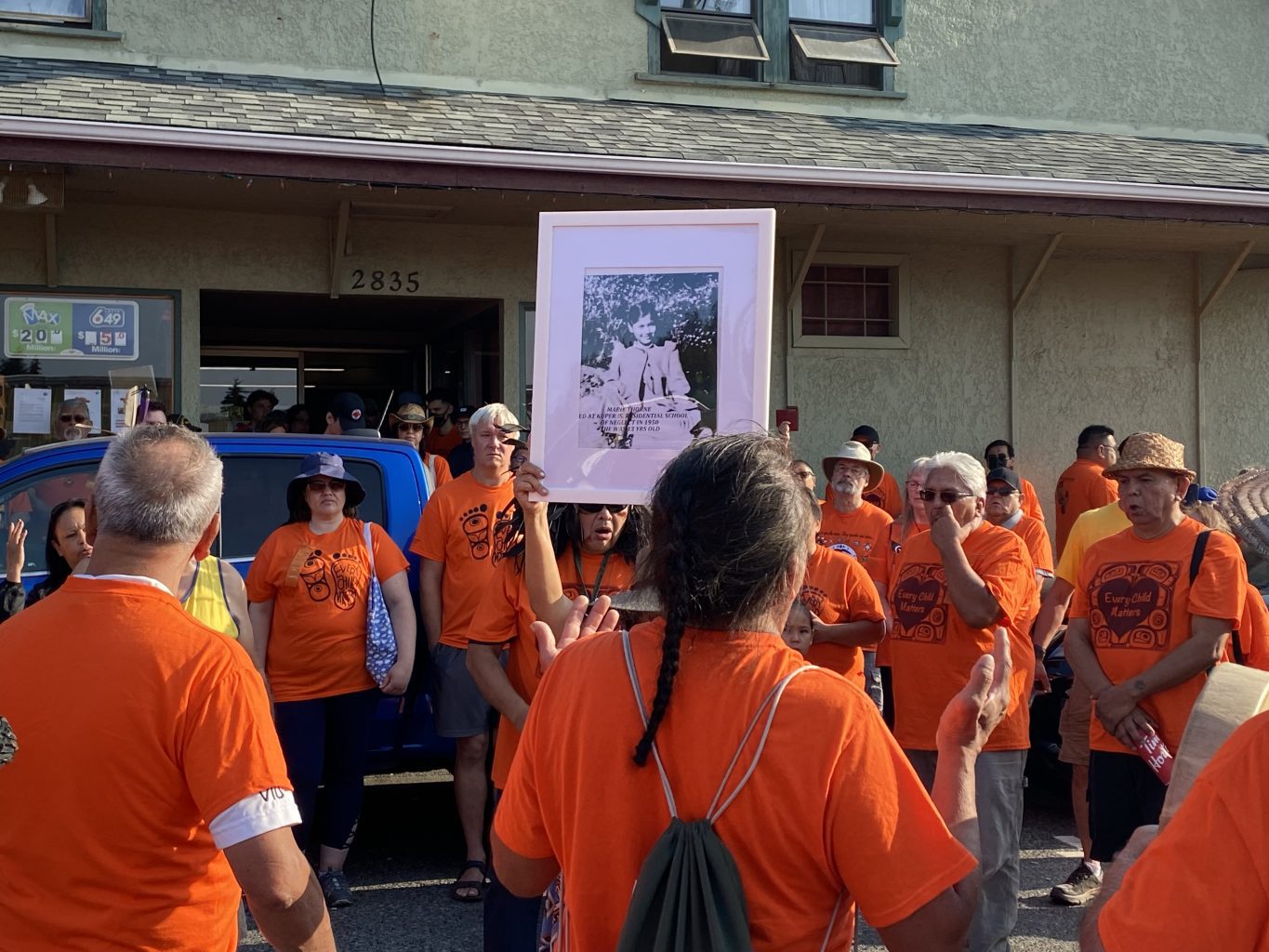
On Monday, August 4, a march to honour the survivors and the children who didn’t return from residential schools in Canada, will take place in Chemainus.
It’s the fifth annual Spune’luxtth’ March for the Children that starts at the Salish Sea Market near the Chemainus ferry terminal and makes it way up to Waterwheel Park.
Several hundred people usually participate in the march that brings awareness to a dark side of Canadian history, the abuse of children by the Christian priests and teachers operating the schools.
More than 130 schools were established across Canada, with the system designed to assimilate the Indigenous population beginning in 1828. An estimated 150,000 children attended the schools, the last of which closed in 1996.
In recent years, a sad truth that families have known for decades, became public when it was revealed that hundreds, perhaps thousands of children died while attending the schools. The search continues for the graves of these young victims.
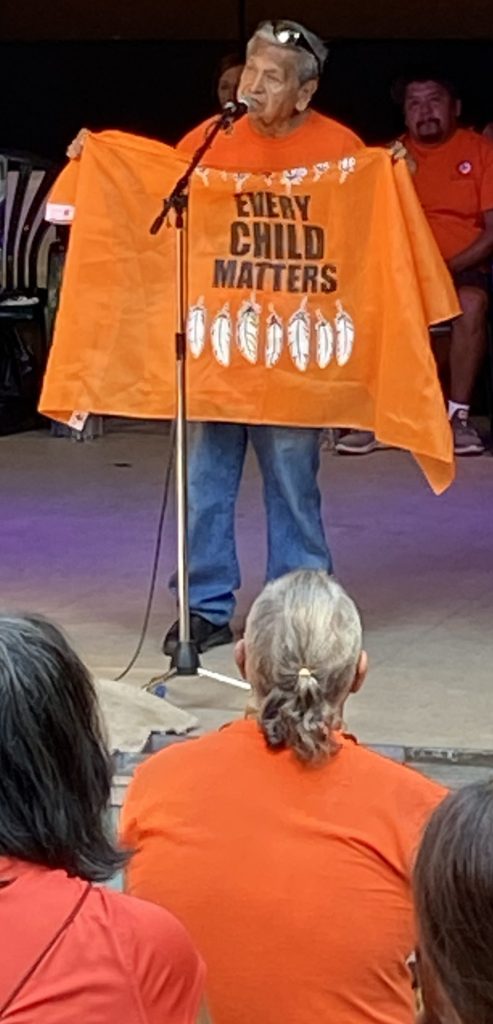
The March in Chemainus begins at 8:30 a.m. and will be followed by drumming, guest speakers and storytelling at Waterwheel Park.
On Penelakut Island, one of the more horrific residential schools was operated by the Roman Catholic Church.
Raymond (Tony) Charlie attended Kuper Island Residential School and six decades later he told his story of enduring unthinkable abuse at the hands of priests including oblate brother Glenn Doughty, who worked at the school from 1967 to 1986. Doughty was convicted in 2002 of sexually abusing students and sentenced to three years, after serving other sentences for sexually assaulting students at other residential schools.
Charlie’s 2022 book, In The Shadow of the Red Brick Building, shed new light on what occurred at Kuper Island Residential School and the impact it had on the Charlie family.
“My late mother Lavina attended during the 1930s, my three brothers James, Mike and Al, my three sisters Sandra, Janice and Becky were also at residential school. We were the second generation to attend the residential school system in our family. My aunts, uncles and many other cousins attended during different years from myself at residential schools.”
Charlie says the damage done by the residential schools carried through several generations and continues to affect families to this day, even though the last school closed more than 25 years ago.
“Many issues we have as a people today have been brought onto us directly as a result of the residential schools we attended across Canada,” he says.
“I lost our beautiful language because my late mother chose not to teach us because her generation was punished for speaking it at the residential school.”
Steve Sxwithul’txw was sent to Kuper Island Residential School when he was only five years old. In 2021, when the Penelakut Tribe said 160 undocumented and unmarked graves had been found on the site of the former residential school, Sxwithul’txw said it should not have been surprising.
“I wouldn’t call it a discovery,” he told Global News at the time. “I think it was something that was bound to be relinquished or unearthed in some shape or form.”
“It’s disheartening, it’s painful, it’s a reflection of a time that wasn’t that long ago,” Sxwithul’txw added.
The school, which was first opened at the site in 1889, became known among the students who attended as Alcatraz, due to its isolated island location and the difficulty to get on and off the island.
The Kuper Island School on Penelakut Island, a 25-minute ferry ride from Chemainus, opened in 1889. Students set fire to the school in 1895 when holidays were cancelled. A survey carried out in that year showed that of 264 former students 107 had died. Two sisters drowned while trying to escape the school in 1959 and another student died by suicide in 1966. The federal government took over the administration of the school in 1969 and closed it in 1975.
Today only a few pieces of concrete remain at the site of the former school that was demolished several years ago.